
Configurator
Rigid Melt Bolt Thermocouple. Mineral Insulated
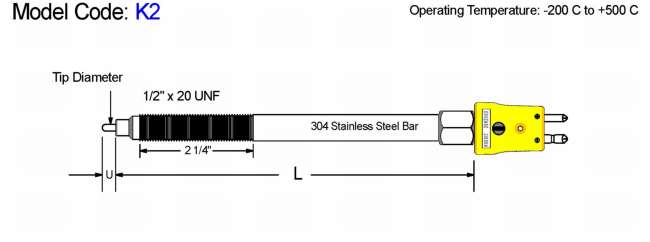
Model Code: K2
Nordic Sensors Rigid Melt Bolt Thermocouple
The Rigid Melt Bolt Thermocouple from Nordic Sensors delivers superior temperature measurement directly from the plastic melt flow in demanding extrusion and injection molding applications. This specialized mineral-insulated temperature probe features an enhanced rigid construction specifically engineered to maintain positional stability when threaded directly into the high-pressure melt channel of extruders and injection molding machines.
The exceptional stability of this rigid design ensures consistent sensor positioning in the melt stream, eliminating measurement variations that can occur with standard probes under high-pressure conditions. This measurement consistency is critical for advanced process control, especially in applications requiring precise temperature management for specialized materials or tight dimensional tolerances.
Unlike conventional surface-mounted sensors, the Rigid Melt Bolt Thermocouple positions its sensing element directly in the polymer melt stream, delivering actual material temperature readings rather than equipment surface temperatures. This direct measurement capability provides essential data for achieving precise thermal control, reducing scrap rates, and optimizing cycle times in high-precision plastics processing operations.
The robust construction of Nordic Sensors' Rigid Melt Bolt Thermocouples features high-density mineral insulation that provides exceptional electrical isolation while maintaining excellent thermal conductivity. This superior insulation ensures measurement accuracy even in the challenging electrical environments and high electromagnetic interference typically found in advanced plastics processing equipment.
Available in multiple thermocouple types including J, K, T, E, and N, these sensors can be configured to match your specific temperature range and accuracy requirements. Type J offers excellent sensitivity in standard processing temperatures, while Type K provides extended range capability for high-temperature engineering polymers. Types T, E, and N are available for specialized applications requiring particular temperature ranges or environmental resistance properties.